Closure notes aren't evidence
“Resolved” says nothing about whether it stayed resolved.
Compass recommends next steps based on past outcomes from your own environment. Your engineers decide. Each verified outcome improves the next recommendation.
For MSPs and multi-client IT service teams.
Works alongside your ITSM.
COMPASS · DECISION LEDGER
Booking requests are degraded.
Revert the recent configuration change
Verified · held 30 daysIllustrative example · sample data
The problem
Tickets get closed, but nobody tracks whether the fix held. So AI tools learn from closure notes, and teams repeat fixes that never worked.
Illustrative example · sample data
“Resolved” says nothing about whether it stayed resolved.
Reopens and repeats hide inside separate tickets.
Attrition and account transitions take resolution knowledge with them.
When a client asks why an action was taken, the reasoning is gone.
How it works
Operentiq records what Compass suggested, what your engineer decided, what was done, and whether it held.
Booking requests are degraded.
Compass suggests a next step with its evidence.
Compass: revert the recent configuration change. Held in 4 of 5 past cases.
Your engineer accepts or rejects, with one tap.
Engineer accepted, with reason: matches last known good.
Your team acts in its own tools. Operentiq records what was done.
Change reverted in the team's own tools.
Operentiq checks reopens and recurrences to confirm the fix held.
No reopen, no recurrence. Fix held.
Each verified outcome improves the next recommendation.
Illustrative example · sample data
See which past fixes were verified and which are just closure notes.
The fix held, confirmed by outcome signals.
Resolved, with partial confirmation.
Closure recorded, outcome unknown.
Evidence grading is in development and rolls out to early-access teams first.
Booking API · Acme Freight
Slower booking responses reported · a recent change is under review
The configuration change was reverted. No reopen or recurrence in the following 30 days.
Resolved after a restart, with one related alert in the following week.
Closed with a short note. Whether the fix held is unknown.
Compare it with the last known good state before deciding what to do.
Similar action held in 4 of 5 past cases for this client.
Illustrative example · sample data
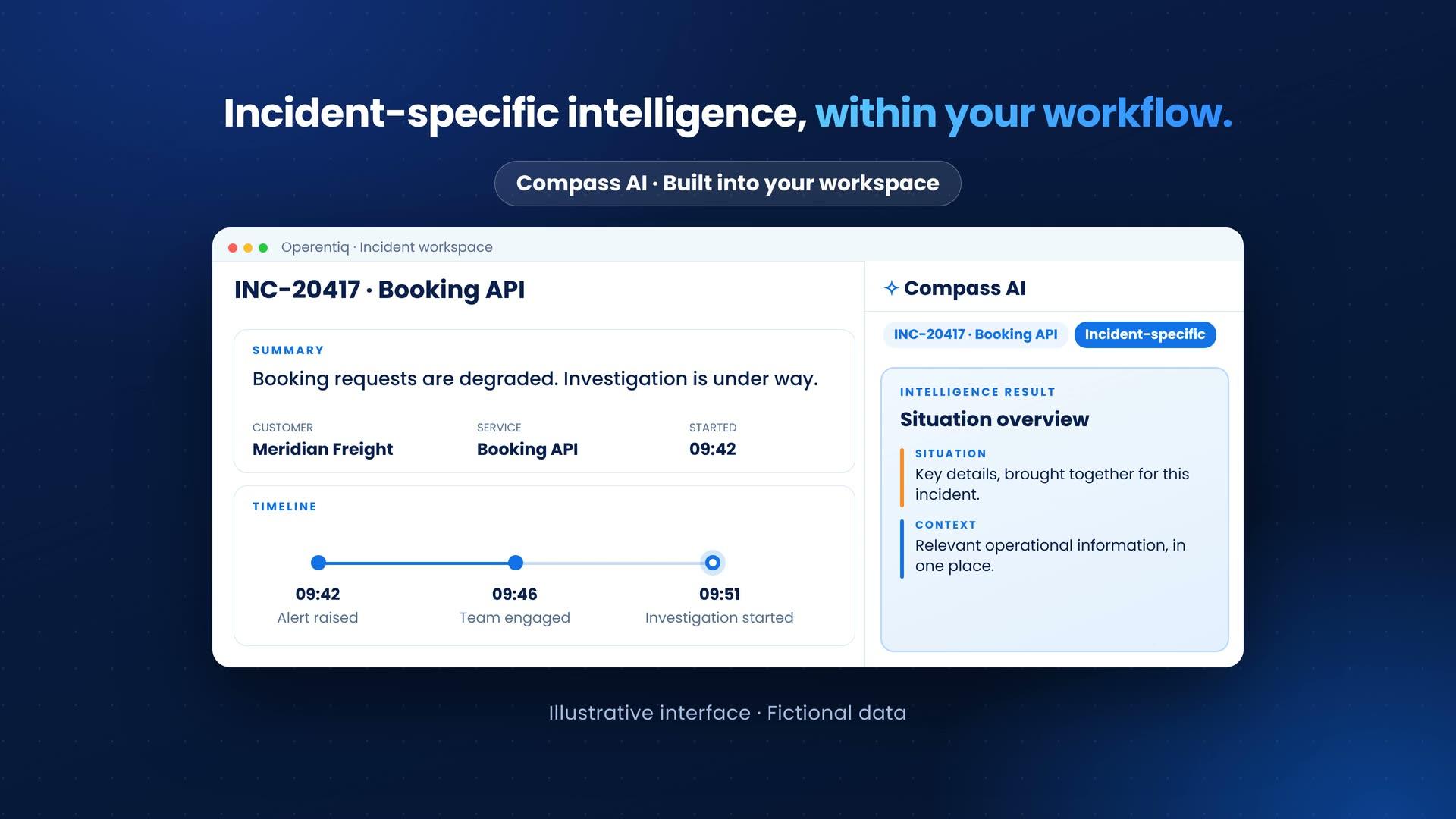
A short walkthrough of the incident workspace and Compass, with your team in control.
Why Operentiq
Your ITSM stays the system of record. Operentiq adds what it doesn't track: whether the fix held.
| ITSM and ticket-based AI | With Operentiq |
|---|---|
| Records that a ticket was closed | Verifies whether the fix held |
| Suggests steps from closure notes | Ranks steps by past outcomes |
| Treats all past tickets as equal | Grades each past fix by evidence |
| Loses the reasoning behind decisions | Keeps who decided, why, and what happened |
| Tied to one platform | Works alongside your existing ITSM |
Use cases
Three places where knowing which fixes held changes the decision.
Who it's for
Built for the people accountable for delivery across client environments.
Prove fix quality across client environments, cut repeat incidents, and keep knowledge through attrition.
See which fixes held across services and teams, and stop repeating the ones that didn't.
Early access pilot
We're working with a small number of IT service teams. Run Operentiq on one team and one service against a baseline we agree with you up front.
Fix durability, repeat-incident rate, and time to decision.
A 45-day pilot at no cost, a read-only connection to your ITSM, and direct access to the founder.
Scope, data handling, and success measures.
No production changes. Your engineers make every decision.
About Operentiq
Operentiq is founded by Balaji Thandra Sitla, who spent 11 years in incident management and service delivery at global firms including McKinsey & Company.
Across those years he saw the same pattern: tickets closed, fixes that did not hold, and teams stuck reacting to the same problems. Operentiq exists to help service operations teams move from reactive to proactive.
“Service teams already have the experience they need. It’s just not there at the moment they need it.”
Operentiq is founder-led. Early-access teams work directly with the founder, with no sales layers or hand-offs.
Connect on LinkedIn (opens in a new tab)Security & data
Operentiq reads incident data from your ITSM through a read-only account we set up with you. It never writes to your ITSM or changes production.
Each customer's data is kept logically separate from every other customer's.
Where data is hosted, how long it is kept, how it is deleted, and how it is processed are agreed with you in writing before a pilot starts.
We are an early-stage company and do not yet hold SOC 2 or ISO 27001 certification. We will complete your security questionnaire before any data is shared.
Please don't email credentials or confidential records. We'll set up a secure way to share data during pilot scoping.
FAQ
What teams ask before a pilot.
Operentiq helps multi-client IT service teams see which fixes actually held. It brings past incidents, runbooks and client context into one view and records every decision and its outcome.
It checks signals your ITSM already records, such as reopens, recurrences and escalations. Engineers can also mark a fix as verified.
Your engineers do. Compass suggests next steps and shows its evidence, but AI can be wrong and records can be incomplete, so every suggestion is reviewed. Operentiq never changes production.
Operentiq connects to your ITSM with read-only access. It works alongside your ITSM; it does not replace it. Tell us which tool you use and we'll confirm what a pilot can include.
A 45-day pilot, free during early access, on one team and one service. We agree a baseline and success measures with you before it starts.
ITSM access is read-only and each customer's data is kept separate. Hosting, retention and processing are agreed in writing before any data is shared. See Security & data above.
Pick one team, measure fix durability, and decide on the evidence.
Or email support@operentiq.com to ask a question.
No suitable time, or Calendly won't open? Use the email above and we'll find one.